



Sociology teaches you how to understand people and the world around them on the basis of research, and what you will learn through the MA in Sociology degree will be useful even beyond the classroom.
The core MA in Sociology skills include research, data management, critical thinking, and communication. The skills can be used in various jobs apart from teaching and NGO positions.
The skills include analytical, research and interpersonal skills. This means you are able to understand data, conduct surveys and interviews, and interact with people from diverse backgrounds.
You are not restricted to one field since this knowledge can be applied to research, policy, the corporate world, and social sectors.
Also, you will learn which subjects enhance which skills and how SPSS, R, and Excel help you to prove your skills. Finally, the jobs section will show how each skill can be applied in practice.
This blog can be considered your skill map for the degree. Here you will see what you will gain semester after semester, where it applies in the workplace, and how to evaluate a syllabus before taking a course.
Core MA in Sociology Skills You Build Semester by Semester
Most MA in Sociology skills grow step by step, so every semester adds something new. Here is how each skill builds across the four semesters of the online MA in Sociology.
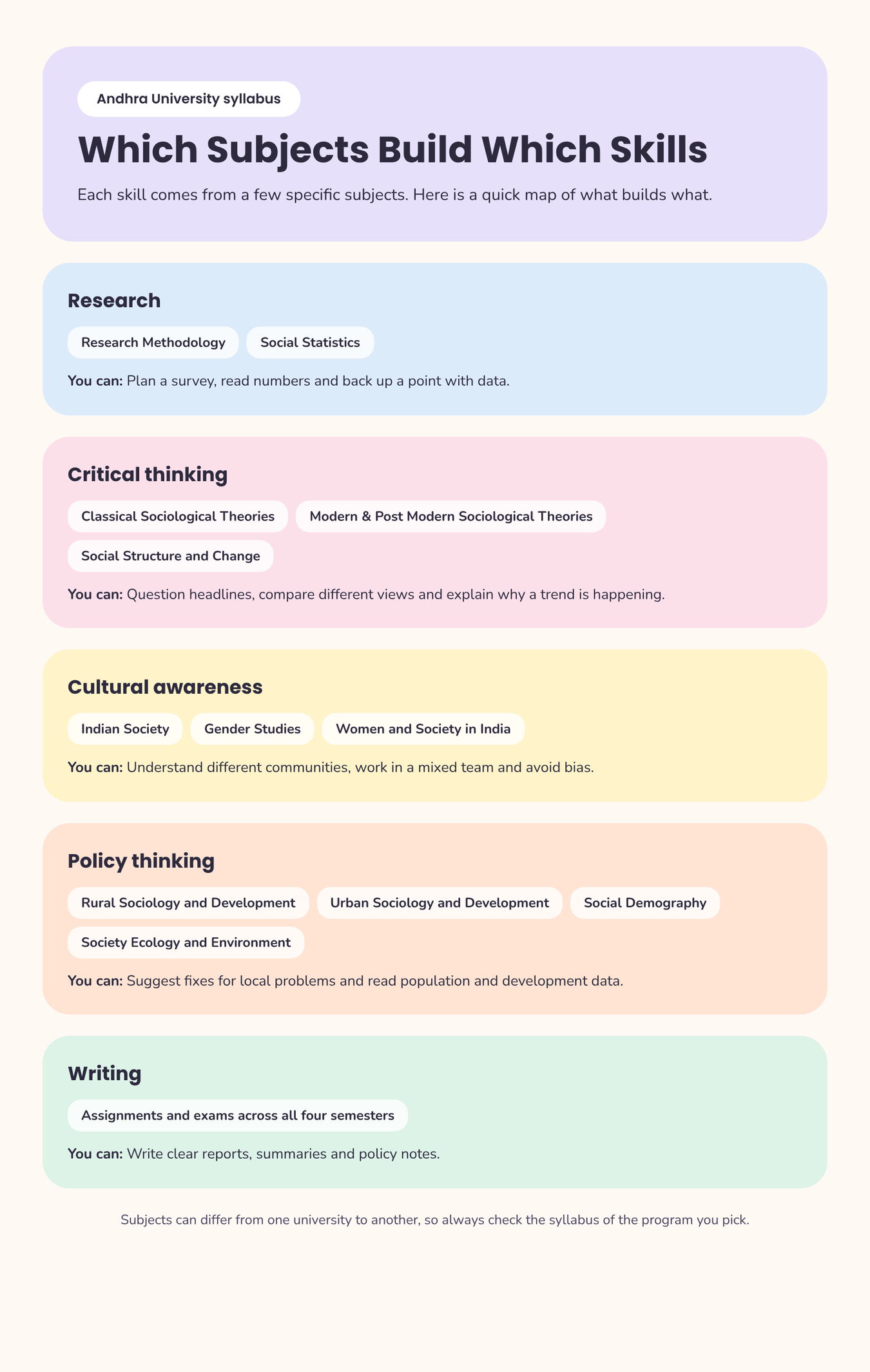
Research and Survey Design
What it is: Asking a good question and answering the same in truth.
Where you learn it: You learn research methods in Semester I. And then, social statistics help you make sense out of numbers in Semester II.
Example: You design a quick survey regarding the reasons for people working as gig in your city. You select whom to interview along with the relevant questions and interpret them using statistical data.
Critical Thinking and Social Analysis
What it is: Not accepting everything at first sight. You begin to think, “What could be the reason behind this?”
Where you learn it: In Classical Sociological Theories of First Semester and Modern & Postmodern Sociological Theories of Second Semester.
Example: A news report tells you that there is an increase in the unemployment rate. You wonder who is most affected are and what is not being told in the news report.
Written and Verbal Communication
What it is: Clear explanation of complex concepts using simple language, both in writing and in oral form.
Where you learn it: Throughout all four semesters, through assignments, written tests and online discussions.
Example: You summarize a lengthy reading on Social Structure and Change in one page that anyone can understand. This skill will be useful for writing reports and policy briefs at work.
Cultural Awareness and Empathy
What it is: Understanding how other people live their lives, without passing any judgments on them.
Where you learn it: Indian Society in Semester I, Gender Studies in Semester III, and Women and Society in India in Semester IV.
Example: You learn how gender determines who goes to school or works outside the home. Then you figure out why a certain policy succeeds in one society but fails in another.
Policy Thinking and Problem Solving
What it is: Finding a practical fix for a social problem.
Where you learn it: In Rural Sociology and Development in Semester III, and Urban Sociology and Development and Social Demography in Semester IV.
Example: A village health scheme has very few users. You look at who lives there, find out why people stay away and suggest simple fixes, like more awareness or information in the local language.
Self Discipline and Digital Comfort
What it is: Managing your own time and feeling comfortable with online tools.
Where you learn it: Just by studying online for all four semesters, using recorded lectures, learning portals and online libraries.
Example: You manage a job, weekly lectures, and exam dates together. This teaches you to plan well and finish what you start.