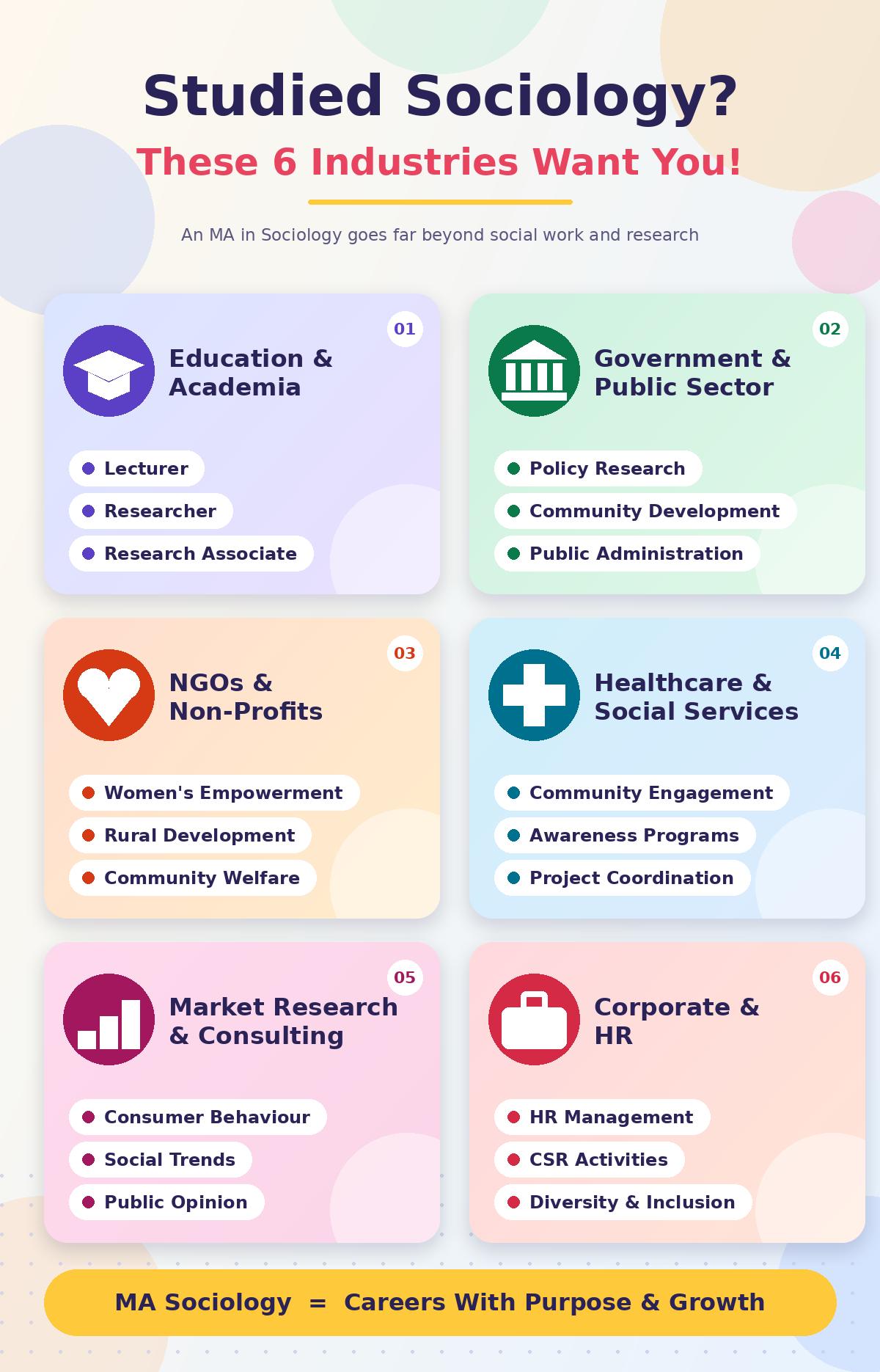
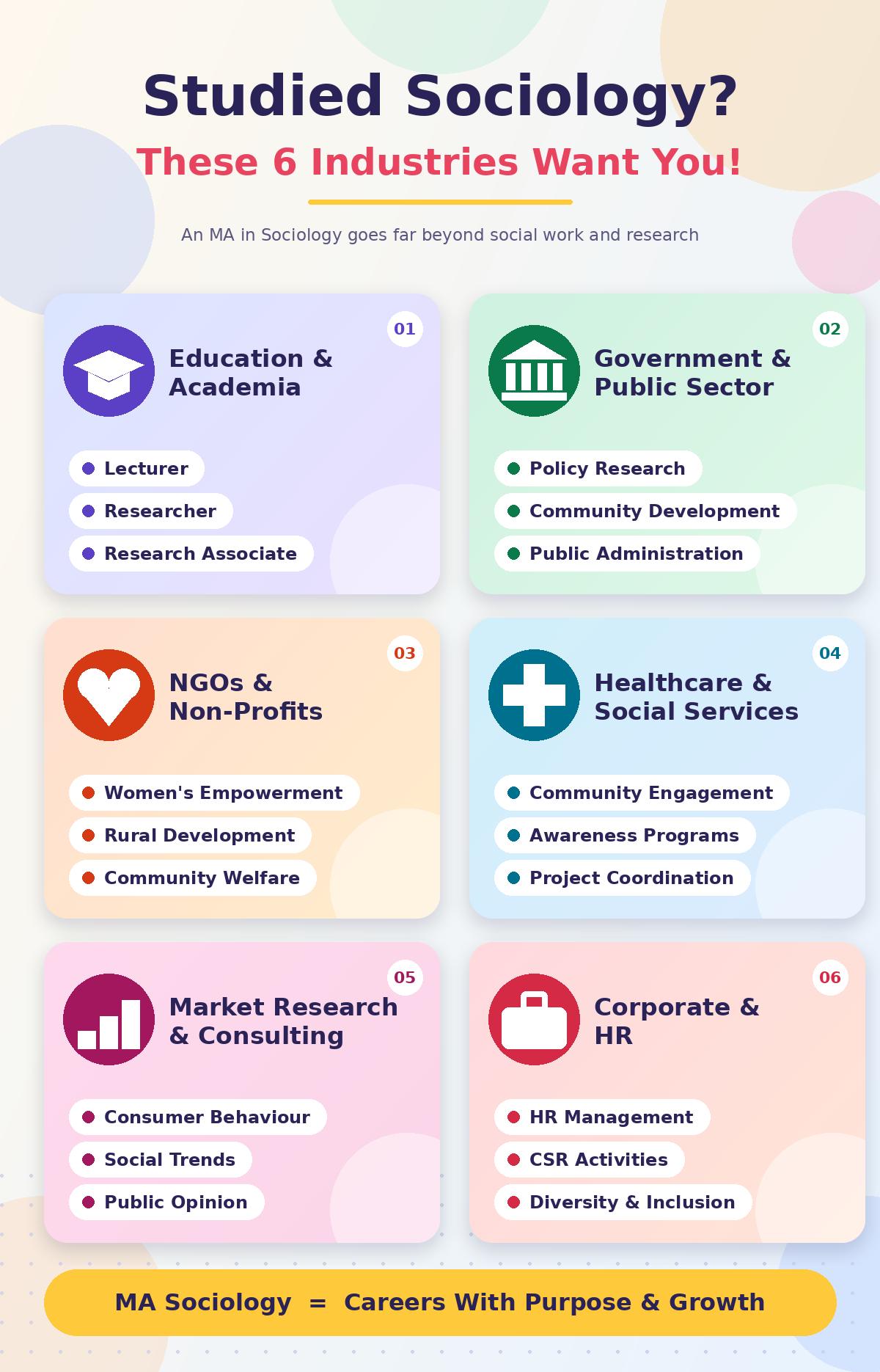
Education and Academia: One can become a lecturer (provided one meets all the eligibility criteria for becoming a lecturer), researcher or research associate in colleges, universities and other educational institutions.
Government and Public Sector: There is scope in government institutions and public policy think tanks for social welfare, policy research, community development and public administration.
NGOs and Other Non-Profit Organizations: You can get engaged with organizations that work for education, empowerment of women, rural development, health campaigns in the public sector, and community welfare.
Health care Industry and Social Services: Hospital services, health-care institutes, and community health projects employ professionals in areas like community involvement, social service programs, awareness programs, and project coordination.
Market Research and Consulting: Research agencies and consulting firms require professionals that understand the behavior of consumers and can conduct studies on social trends and public opinion.
Corporate Sector and Human Resource Management: Corporate houses can provide employment in areas like Human resource management, CSR activities, employee development, and diversity & inclusiveness.
The long-term scope of work in these industries will depend on your experience, knowledge, and the skills that you will acquire.
Also Read: Top Career Options After Online MA in Sociology
What Government Jobs Can You Pursue After an MA in Sociology?
After completing an MA in Sociology, you can explore government career opportunities in administration, social welfare, and research. Some options include:
Civil Services
IAS, IPS and State Administrative Services: You can appear for UPSC Civil Services or State PSC examinations. Sociology is also an optional subject in the UPSC Mains examination.
Social Welfare Department Jobs
Social Welfare Officer: Help implement government welfare schemes and support disadvantaged communities.
Child Development Project Officer (CDPO): Oversee child development, nutrition, and welfare programmes, subject to recruitment eligibility.
District Social Welfare Officer: Coordinate and monitor social welfare programmes at the district level.
Government Research Opportunities
Research Assistant: Assist with government-funded social research, surveys, and data collection.
Research Investigator: Conduct field studies on social and economic issues.
Project Associate: Support research projects related to public policy and community development.
Note: Eligibility varies across government positions. Some roles require specific qualifications, competitive examinations, or relevant work experience.
What Courses Can You Pursue After an Online MA in Sociology?
After pursuing your Online Master’s Degree in Sociology, you have the option to pursue additional education or specialized courses. Your decision will be based on your career aspirations and preferences. Some choices include:
PhD in Sociology: If you love conducting research and wish to learn about social issues in depth, then pursuing a PhD may help you create a career in academic circles or social research.
Postgraduate Diploma in Social Work: This program will help you gain practical skills in community development, social welfare and working with various types of people.
Postgraduate Diploma in Public Policy: In case you have an interest in government and policy-related jobs, then this program can help you learn about public policy planning and implementation.
Certificate Course in Data Analytics: Skills of data analytics and research will be useful while dealing with surveys, social research and market research.
Certificate Course in Human Resource Management: If you wish to pursue careers in corporates, then this program will help you learn about recruitment, employee relationships and behaviour at workplace.
UGC NET in Sociology: In case you would like to become a teacher at colleges and universities, then you can get prepared for UGC NET in Sociology, subject to the necessary eligibility criteria.
Turn Your Interest in Society into a Meaningful Career! Take your next academic step with Andhra University's Online MA in Sociology. Explore social issues, understand human behaviour, and develop skills that can open doors to diverse career opportunities. Flexible online learning Research-oriented curriculum Two-year programme duration NAAC A++ accredited university
Ready to take the next step? Explore the Online MA in Sociology |
What Salary Can You Expect After an MA in Sociology?
Once you get your MA in Sociology, you have the opportunity to earn various amounts of money depending on which job you take up and your level of experience. In this paper, we will consider the amount of money that one earns and the salary progression.
Entry-Level Salary
If you are beginning your career after earning a Master’s in Sociology, you may want to consider jobs like Research Assistant, Social Worker, HR Executive, or Programme Coordinator. The average salaries for these occupations are:
Job Role | Annual Salary |
Research Assistant | ₹3 lakh – ₹6 lakh |
Social Worker | ₹1 lakh – ₹6 lakh |
HR Executive | ₹3 lakh – ₹6 lakh |
Programme Coordinator | ₹3 lakh – ₹6 lakh |
(Glassdoor)
Mid-Level Salary
After working for a few years, you will be able to engage in jobs that require research, policy analysis, and social development projects management. You may also receive increased pay, as your knowledge grows with time.
Job Role | Annual Salary |
Research Analyst | ₹3 lakh – ₹8 lakh |
Policy Analyst | ₹4 lakh – ₹10 lakh |
Programme Coordinator | ₹3 lakh – ₹6 lakh |
(Glassdoor)
Senior-Level Salary
Once you have gained enough experience and find yourself in leadership positions, you can go for jobs like Senior Research Analyst, Senior Programme Coordinator, or Programme Manager. These types of jobs require you to lead teams and make important decisions.
Job Role | Annual Salary |
Senior Research Analyst | ₹6 lakh – ₹10 lakh |
Senior Programme Coordinator | ₹3 lakh – ₹7 lakh |
Programme Manager | ₹15 lakh – ₹30 lakh |
Factors Affecting Salary Growth
Your salary may rise, but there are several key factors to be considered as well:
Experience at Work: Those who have work experience stand to get highly paying jobs and managerial roles.
Nature of Work: Research, social work, Human Resource Management (HRM), public administration, and program management have varying levels of salaries.
Specialised Knowledge: Information on research methodology, data analysis, report writing, and programme/project management increases your chances of employment.
Organisation: The kind of organisation will determine the structure of remuneration; government agencies, research organisations, NGOs, universities, and private organisations will all pay differently.
City and Living Standards: Different cities will offer varying job opportunities and salary structures.
What Skills Can You Develop Through an Online MA in Sociology?
An MA in Sociology through Online Learning allows you to learn about people, society, and social problems that influence your daily life. Besides knowledge about the subject, you will also acquire skills that might prove useful in various careers. The skills you can acquire include:
Research Skills: Learn how to collect data, conduct surveys, interview individuals and analyze various social issues.
Analytical Skills: Learn how to analyze social trends, identify problems and interpret research results.
Communication Skills: Learn how to express yourself, write reports and communicate with people from different communities.
Problem Solving Skills: Learn how to analyze social problems from various perspectives and come up with solutions to those problems.
Critical Thinking Skills: Learn about social problems, ask questions and think critically about what you know about the situation at hand in order to make decisions.
Interpersonal Skills: Gain more knowledge and understanding about various communities and social behaviour.
These skills can help you in careers related to social research, education, public policy, HR, community development, and social welfare.
Why Choose Andhra University for an Online MA in Sociology?
When you need to pursue Sociology and balance other responsibilities, the Andhra University can provide you with a flexible online MA program, complete with a curriculum dedicated to research. There are several reasons why you should choose this university.
Recognized University: The Andhra University has been accredited by NAAC A++ and stands 23rd among Universities in NIRF 2025. Andhra University offers an Online MA Sociology program, which is accredited by the UGC.
Study Flexibility: You can view lecture recordings, access learning materials, and complete assessments through the Internet. Hence, you can study whenever you wish to do so.
Course Structure: The course content comprises sociological theories, Indian society, research methods, social statistics, and social development.
Live Interactive Sessions: You can attend live classes and interact with faculty and other learners over subjects during the sessions.
Affordable Fee Structure: The program fee of ₹57,500 includes the registration fees and exam fees.
Program Duration: You have two years to complete your MA in Sociology program. In any case, it is possible to do it within four years.
Conclusion
The Online MA in Sociology is a good choice for you if you wish to gain knowledge about society and you are thinking of making a career in the field of research, teaching, social work, public policy, or any other field. This course will help you gain some important skills, know about different career opportunities, and prepare for higher education. In case you are thinking of pursuing higher education in a flexible mode of learning, the Online MA in Sociology from Andhra University can be your choice.