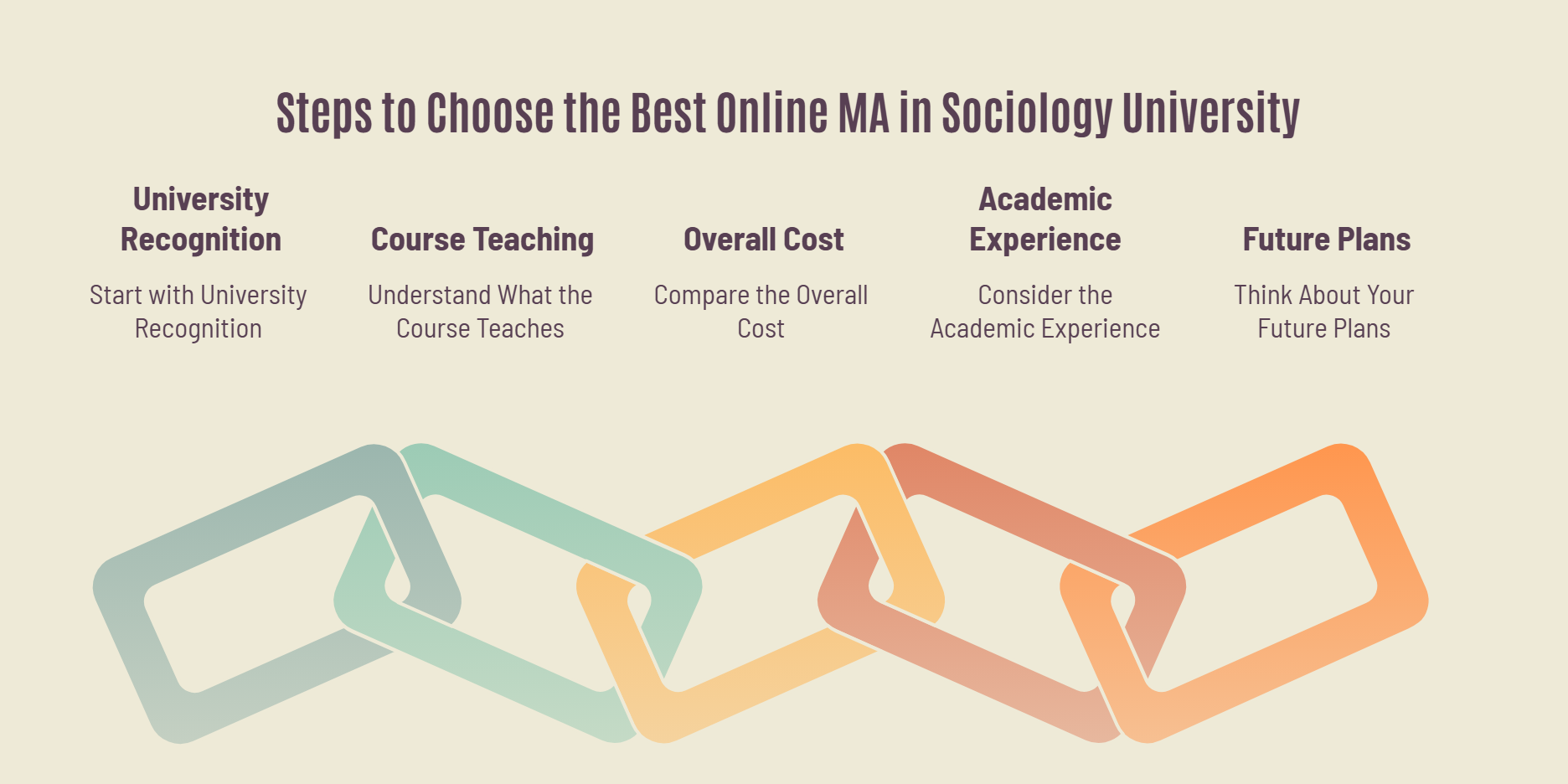
Step 1: Start with University Recognition
A recognised degree is important for further education and employment opportunities. Universities offering online postgraduate programs must meet the applicable UGC-DEB requirements. This establishes the regulatory standing of the qualification.
Step 2: Understand What the Course Teaches
An MA in Sociology should cover more than basic social concepts. Subjects such as sociological theories, social institutions, research methods and contemporary social issues help students develop a broader understanding of society.
Step 3: Compare the Overall Cost
Look at the complete program fee rather than focusing only on the admission fee or semester payment. Consider additional charges, payment flexibility and available scholarships.
Step 4: Consider the Academic Experience
Faculty expertise, teaching methods, study materials and opportunities for interaction contribute to the quality of education. A well-organised online learning environment can make postgraduate study more manageable.
Step 5: Think About Your Future Plans
Your choice should also reflect what you want to do after graduation. If you are interested in research, look for a strong research methodology component. If you want to work in social development, subjects covering communities, inequality and public policy may be particularly relevant.
How to Check UGC Recognition and Accreditation of Online MA Sociology Universities?
UGC recognition and UGC-DEB entitlement are important when choosing an online postgraduate program. While UGC recognises higher education institutions, DEB regulates their online and distance learning programs. A university must have the required entitlement to offer an Online MA in Sociology.
The following table explains the major recognition and accreditation factors.
Recognition Factor | What It Means | Why It Matters |
UGC Recognition | Recognition of the university under UGC regulations. | Establishes the university's status as a recognised higher education institution. |
UGC-DEB Entitlement | Approval or entitlement to offer a specific program in online mode. | Establishes whether the online MA Sociology program can be offered for the relevant session. |
NAAC Accreditation | Assessment of an institution's academic and institutional quality. | Provides information about the university's overall academic standards. |
University Status | Whether the institution is a central, state, private or deemed university. | Helps students understand its institutional background. |
Recognition Validity | Applicability of recognition and entitlement to a particular admission session. | Ensures the qualification falls under the relevant regulatory framework. |
How to Compare Online MA in Sociology Fees, Duration and Eligibility?
Online MA in Sociology fees, duration and eligibility vary across universities. Comparing these factors helps you understand the course cost, time commitment and admission requirements before applying.
Here is a comparison of the main factors.
Criteria | Common Structure | What Makes It Important |
Course Duration | Generally 2 years, divided into 4 semesters. | Provides sufficient time to study core subjects and complete assessments. |
Total Fees | Varies depending on the university and program structure. | Helps you understand the complete financial commitment. |
Semester Fees | Payable at the beginning of each semester in some universities. | Makes fee planning easier. |
Eligibility | Generally requires a recognised bachelor's degree. | Determines whether your undergraduate qualification meets admission requirements. |
Minimum Marks | May vary between universities. | Some institutions may specify minimum qualifying marks. |
Admission Process | Usually involves an application, document submission and fee payment. | Helps students understand the steps involved in enrollment. |
If you are still evaluating whether an online postgraduate degree is the right choice, read our guide on whether an Online MA in Sociology is worth it to understand its value, career opportunities, costs and benefits before making a decision.
What Should You Check in the Online MA Sociology Curriculum and Specialisations?
The curriculum shapes your learning experience and understanding of Sociology. A well-structured program should cover social institutions, inequality, urbanisation and globalisation while connecting sociological concepts to real-world issues.
Some important subjects and areas of study include:
Sociological Theories: Explores the ideas of classical and contemporary sociologists and how their theories explain social behaviour and institutions.
Indian Society: Covers caste, class, religion, family, communities and cultural diversity in the Indian context.
Social Change and Development: Examines urbanisation, modernisation, globalisation and changing social relationships.
Research Methodology: Introduces qualitative and quantitative research, sampling, data collection and interpretation.
Gender and Society: Explores gender roles, inequality, social movements and changing power structures.
Rural and Urban Sociology: Studies rural communities, urban development, migration and changing patterns of settlement.
Why is research methodology important?
Understanding Social Issues: Research methodology helps students study social problems, collect information and interpret findings.
Research Methods: Topics may include surveys, interviews, demographic data and qualitative research.
Practical Research Skills: Assignments, projects and dissertations help students develop research and analytical abilities.
Curriculum Relevance: Subjects should align with students' interests and provide a strong foundation in sociological research.
Choose the Right Online MA in Sociology for Your Academic GoalsLooking for a university that offers a recognised qualification, relevant curriculum and flexible learning? Andhra University's Online MA in Sociology gives students an opportunity to explore social structures, sociological theories and research methods while pursuing postgraduate education online. Why consider Andhra University's Online MA in Sociology? Build a strong foundation in sociological concepts and theories. Study subjects related to Indian society, social structures and research methodology. Develop an understanding of social issues through a research-oriented curriculum. Pursue postgraduate studies through a flexible online learning format. Access learning resources and recorded lectures through the LMS, along with live interactive sessions.
Explore the Online MA in Sociology from Andhra University Online to learn more about the program, curriculum and admission requirements. |
How to Compare Faculty Expertise and University Reputation?
Faculty qualifications and teaching experience influence the quality of learning. A university's reputation also matters, but it should be considered alongside the academic quality of its specific program.
Here are some aspects that contribute to a university's academic credibility:
Academic Qualifications: Faculty members with relevant postgraduate and doctoral qualifications bring subject knowledge to the classroom.
Teaching Experience: Experienced educators can explain sociological concepts through academic examples and real-world discussions.
Research Contributions: Faculty involvement in research papers, publications and academic projects adds to the institution's research environment.
Institutional History: A university's experience in higher education reflects its academic background and development.
Academic Recognition: UGC recognition and NAAC accreditation provide important information about institutional standing.
For an MA in Sociology, faculty expertise in areas such as social theory, Indian society, gender studies and research methodology can be particularly useful.
University rankings can provide additional context, but they should not be treated as the only measure of academic quality.
How to Evaluate the Learning Format and Student Support Offered by Universities?
Online education offers flexibility for graduates and working professionals. A good learning experience should also include accessible study materials, regular assessments and opportunities to interact with faculty.
Here are some features that contribute to a better learning experience:
Learning Management System (LMS): A central platform for accessing study materials, lectures, assignments and academic updates.
Recorded Lectures: Allow students to revisit lessons and study at a convenient time.
Live Interactive Sessions: Provide opportunities to discuss topics, ask questions and interact with faculty.
Digital Study Materials: E-books, lecture notes and reference materials support independent learning.
Examination Facilities: Clear examination schedules, assessment guidelines and information about evaluation methods help students plan their studies.
Academic Support: Faculty assistance and student support services help learners address academic and administrative queries.
For working professionals, recorded lectures and flexible study schedules can make it easier to balance education with professional responsibilities.
Students who are new to Sociology may also benefit from regular academic interaction, especially when studying theoretical concepts or working on research assignments.
Working professionals comparing flexible postgraduate options can also explore our guide to the best Online MA in Sociology for working professionals to understand the factors that matter when choosing a suitable online program.
What Career Support and Opportunities Should You Look for?
An MA in Sociology offers academic and career opportunities across sectors such as research, education, social development and public policy. Research exposure and career guidance can further support students' professional growth.
Some useful forms of career support include:
Career Guidance and Placement Assistance: Career counselling and placement support, where available, can help students understand relevant job roles and employment opportunities.
Internship and Research Opportunities: Research projects and internships provide exposure to social issues, community development and data collection.
Alumni Network: An active alumni network can help students connect with graduates, learn about career paths and gain professional insights.
Some career areas available to Sociology graduates include:
Career Area | Potential Job Roles | Annual Average Salary |
Research and Academia | Research Assistant, Social Researcher | INR 4.2 LPA, INR 11.6 LPA |
NGOs and Social Development | Project Coordinator, Program Associate | INR 5.6 LPA, INR 9.1 LPA |
Education | Academic Assistant, Teaching-related roles | INR 3.6 LPA, INR 2.5 LPA |
Public Policy | Policy Research Assistant, Program Analyst | INR 5.7 LPA |
Corporate Sector | HR Executive, Employee Engagement Associate | INR 3.7 LPA, INR 3 LPA |
Social Welfare | Community Development Officer, Social Welfare Associate | INR 4.9 LPA |
Source: AmbitionBox and Glassdoor
Teaching positions and academic research careers may require additional qualifications, such as a NET qualification or a PhD, depending on the position and applicable regulations.
Why Choose Andhra University for an Online MA in Sociology?
Andhra University Online has an established presence in Indian higher education. Founded in 1926, the university has contributed to academic development across several disciplines.
For students interested in Sociology, the university provides an opportunity to pursue postgraduate education through its Online MA in Sociology.
Some aspects that make Andhra University relevant to students considering this program include:
Established University: Founded in 1926, Andhra University has a long academic history in higher education.
Flexible Study Option: The online mode allows students to pursue postgraduate education without the need for regular campus attendance.
Research-Oriented Subject: Sociology encourages students to understand social issues through theoretical learning, research methods and critical analysis.
Academic Foundation: The university's presence across multiple academic disciplines provides a broader institutional learning environment.
An Online MA in Sociology from Andhra University can be considered by graduates who want to deepen their understanding of society while continuing with other personal or professional commitments.
The course is particularly relevant for learners interested in social research, education, community development and further academic studies.
Conclusion
Choosing a university for an Online MA in Sociology is also about finding an academic environment that supports your curiosity about society and the issues that shape it. The right learning experience can help you look at social questions from different perspectives and build a deeper understanding of the world around you.
With its long academic history, Andhra University offers an option for graduates looking to continue their education in Sociology. If you are ready to take your interest in society further, explore the Online MA in Sociology at Andhra University and take the next step in your academic journey.