































Online MBA in Data Science & Analytics
For those interested in using data to solve business problems, make informed decisions and build data-driven strategies, the Online MBA in Data Science & Analytics at Andhra University offers a way to combine management knowledge with analytics expertise. You can specialise in this field while continuing your job without relocating.
Know More About Online MBA Data Science & Analytics at Andhra University
An Online MBA program in Data Science and Analytics combines the business side of an MBA with the analytical side of data science. Think management decisions, but with numbers, patterns and evidence entering the conversation.
At Andhra University, Data Science & Analytics is one of the nine specialisations listed under its Online MBA. The program has a two-year duration and is delivered in online mode.
The management foundation includes subjects such as:
Management Process & Behaviour
Quantitative Techniques for Managerial Decisions
Business Environment
Accounting for Decision Making
Managerial Economics
These subjects form the first-semester foundation of the program.
The data and analytics side focuses on understanding how information can support business questions, planning and decision-making.
In practical terms, the specialisation is about connecting two questions:
What is happening in the data?
What does it mean for the business?
Why Choose Andhra University for Online MBA Data Science & Analytics?
Andhra University brings a long academic history to its online MBA offering. The university was founded in 1926 and offers programs in various fields.
For its current Online MBA, Andhra University lists:
Duration: 2 years
Mode: Online
Specialisations: 9
UGC entitled
NAAC A++
NIRF Ranked 23rd nationally
Learning format: Online learning with digital academic resources and case-based learning
The university also highlights real-world case studies and Gen AI applications. For someone looking for a management degree with an analytical direction, the specialisation offers a way to study business fundamentals without completely leaving data-related learning behind.
What Makes Data Science & Analytics an Important MBA Specialisation?
Businesses generate a vast amount of data. The difficult thing about this is being able to know which of these should be given importance.
Data Science & Analytics provides order for all that chaos.
It can be useful for:
Understanding customer behaviour
Measuring business performance
Finding patterns in sales data
Studying marketing performance
Supporting financial analysis
Improving operational decisions
Forecasting possible trends
Supporting strategic planning
Analytics can also connect different departments. Whereas the marketing group considers campaign performance, the financial department focuses on revenue, and the operational department considers efficiency.
While the information may vary, the basic question always remains: What does the data say?
Key Highlights
Below is the quick-scan version of the Andhra University Online MBA Data Science & Analytics program.
₹62200 | |
Benefits and Advantages
Online MBA in Data Science & Analytics offers an opportunity for students to combine their management knowledge and analytical skills.
Build Business Analytics Knowledge
The biggest advantage is the combination of business thinking and analytical thinking.
Students can learn to:
Understand business data
Connect data with organisational goals
Interpret business performance
Identify patterns and trends
Look at business problems through an analytical lens
Instead of asking only, "What happened?", analytics encourages a second question: "Why did it happen?"
Develop Data-Driven Decision-Making Skills
Good business decisions need context. Data can provide part of that context.
An Online MBA Data Science & Analytics can help learners understand how organisations use information to:
Identify trends
Measure performance
Compare business outcomes
Support planning
Examine customer behaviour
Evaluate business decisions
The goal is not to let a spreadsheet run the company. Thankfully.
The point is to use evidence alongside business judgement.
Strengthen Statistical and Analytical Thinking
Statistics may be intimidating to understand until one understands how common its application is among businesses.
It can help with:
Understanding numerical information
Interpreting data
Identifying patterns
Comparing outcomes
Understanding relationships between variables
Supporting quantitative decision-making
Andhra University's first-semester Online MBA structure includes Quantitative Techniques for Managerial Decisions.
Understand Predictive Analytics
Prediction involves analyzing past data in order to predict future events.
It can be applied to areas such as:
Sales forecasting
Demand planning
Customer behaviour
Business performance
Trend analysis
Risk assessment
The exact depth of predictive analytics depends on the university's curriculum, so students should check the detailed syllabus before enrolling.
Develop Management and Strategic Skills
Data does not exist in a vacuum. Someone still has to decide what the business should do with it.
MBA learning can help students connect analytical findings with:
Business strategy
Management decisions
Planning
Communication
Organisational objectives
Resource allocation
That management context is one of the major differences between studying analytics purely as a technical subject and studying it through an MBA.
Understand Technology-Enabled Analytics
Technology is increasingly tied to analytics, but the exact tools covered depend on the curriculum.
Depending on the program, students may encounter:
Data visualisation
Business intelligence
Artificial intelligence
Machine learning
Databases
Programming
Big data technologies
Ideal Candidates
An Online MBA Data Science & Analytics can work for people at different stages of their careers, from fresh graduates figuring out their direction to professionals looking to add analytics to their existing skill set.
Fresh Graduates Interested in Analytics
This program can suit graduates who like both business and numbers.
It may be relevant for learners who want to:
Understand management fundamentals
Explore business analytics
Develop data-oriented thinking
Build a business-focused analytics profile
Working Professionals
Working professionals are one of the obvious audiences for online education.
The program can be relevant to professionals working in:
Business
Finance
Marketing
Operations
Sales
Technology
The online format allows learners to pursue postgraduate education without necessarily stepping away from their existing professional commitments.
Business and Management Professionals
If your work already involves reports, metrics and performance numbers, you probably encounter analytics more often than you realise.
The program can help professionals understand:
Business performance data
Key metrics
Trends
Decision-making
Analytical interpretation
Data and Analytics Professionals
Business analysts, data analysts and related professionals may want broader management knowledge alongside their existing analytical exposure.
The MBA component can add understanding of:
Strategy
Management
Business functions
Organisational decision-making
Leadership
Professionals Planning a Career Switch
Professionals from different backgrounds may consider this specialisation when moving towards analytics-oriented business work.
Relevant backgrounds can include:
Commerce
Management
Technology
Finance
Operations
Business functions
The actual career transition will still depend on skills, experience and the requirements of the target role.
Entrepreneurs and Business Owners
Business owners deal with data every day, whether they call it analytics or not.
The program can help them think more systematically about:
Customer behaviour
Sales performance
Marketing results
Business operations
Market trends
Business growth
Sometimes the most useful business question is simply, "Why did this number change?"
Teaching Methodology
The teaching approach combines live instruction, digital study material and practical learning activities. The idea is to keep online learning flexible while still giving students enough academic structure.
Live and Recorded Learning Sessions
Online learning can be flexible without becoming a one-way lecture marathon.
Andhra University's online learning model includes:
Live interactive online sessions
Tutorials
Digital learning resources
Recorded learning material
Faculty interaction through online learning channels
This allows learners to attend structured sessions while also using digital resources for revision.
Case Study-Based Learning
Analytics becomes much easier to understand when there is an actual business problem attached to it.
Case studies can help learners explore situations involving:
Customer analysis
Sales forecasting
Marketing performance
Business performance
Operational decisions
Andhra University specifically highlights exposure to real-world case studies.
Assignments and Projects
Assignments provide a chance to move beyond simply reading definitions.
Depending on the program structure, academic work may involve:
Data analysis
Case analysis
Presentations
Research activities
Business problem-solving
Projects
The exact project requirements should be checked in the latest program documentation.
Digital Learning Platform
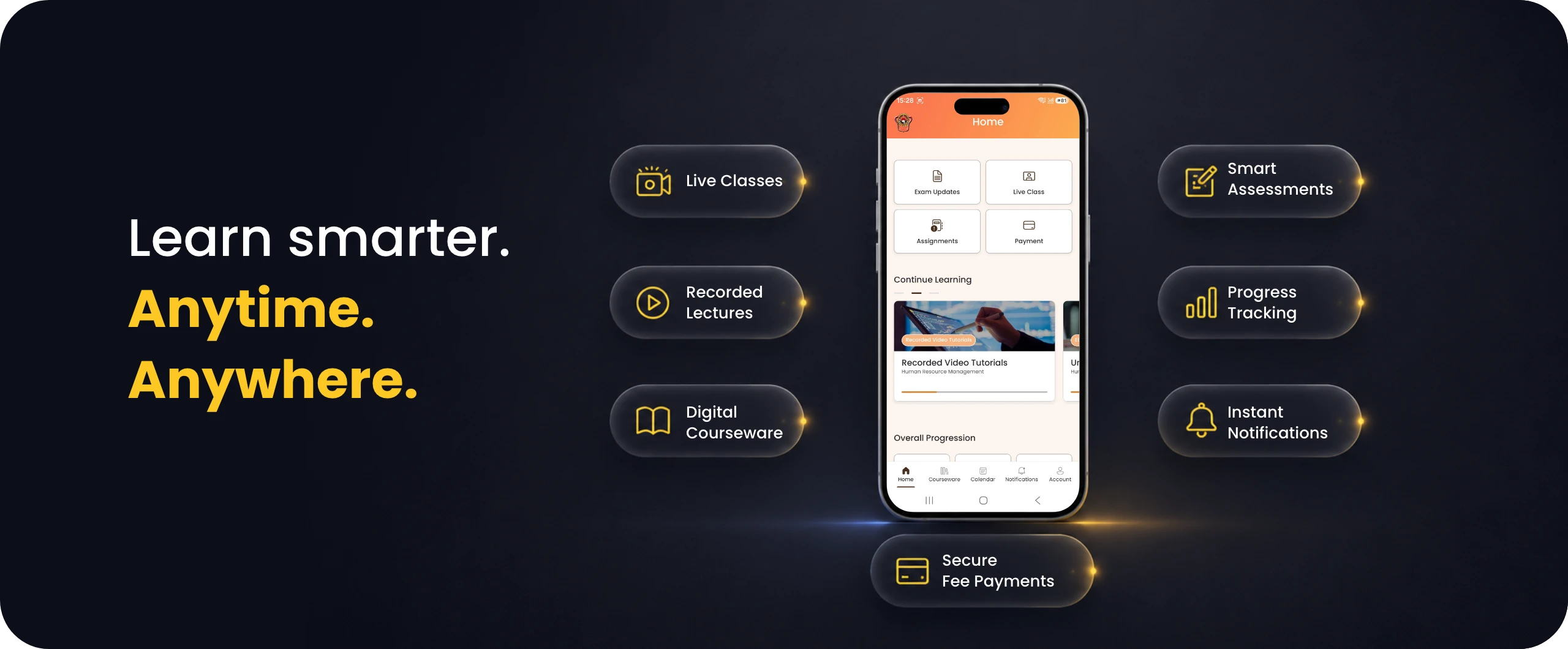
The LMS becomes the student's online academic hub.
It can bring together:
Lectures
Study material
Digital textbooks
Assignments
Tutorials
Assessments
Discussion resources
Practice activities
Andhra University's online learning information highlights digital academic resources and LMS-based learning support.
Examinations and Assessment
Assessment depends on the university's prescribed examination framework.
For Andhra University, students should refer to the latest examination guidelines for details on:
Internal assessment
External examinations
Passing requirements
Examination procedures
Evaluation rules
Eligibility
The eligibility requirements for Andhra University's Online MBA are fairly straightforward. Students should check the academic qualification, marks requirement and documents carefully before starting the application.
Educational Qualification
Andhra University's current Online MBA eligibility requires:
A bachelor's degree of at least 3 years' duration
10+2 qualification
At least 50% marks in the qualifying examination
The university states that candidates from reserved categories require at least 45% marks.
A technical bachelor's degree is not specifically listed as mandatory.
Minimum Marks
The current requirement is:
General applicants: Minimum 50%
Reserved category applicants: Minimum 45%
These requirements are based on the university's current Online MBA program information.
Work Experience Requirements
Prior work experience is not listed as a mandatory eligibility requirement. That means the program is not restricted to professionals already working in data science or analytics.
Entrance Examination Requirements
The current eligibility information focuses on:
Bachelor's degree
Minimum duration of the degree
10+2 qualification
Required percentage
Students should verify the latest admission instructions for any additional selection requirements applicable to their admission cycle.
Documents Required
Applicants should keep commonly requested documents ready, including:
Bachelor's degree certificate
Academic marksheets
10th certificate
12th certificate
Identity proof
Recent photograph
Other documents requested by the university
Always check the official admission instructions before uploading documents.
Admission Process
The admission process for Andhra University's Online MBA follows a series of straightforward online steps. From registration to getting access to the learning platform, most of the process can be completed digitally.
Online Registration
The first step is registering through the official Andhra University online admission process.
Students should:
Open the official admission portal
Register using the required details
Select the Online MBA
Choose the relevant specialisation
Complete the registration requirements
Application Form
Once registered, enter the required personal and academic information.
Before submitting:
Check your name
Verify academic details
Check contact information
Review the selected program
Correct any errors
Small mistakes here can become surprisingly annoying later.
Document Submission
Upload the required documents in the format specified by the university.
This may include:
Academic certificates
Marksheets
Identity proof
Photograph
Other supporting documents
Eligibility Verification
The submitted information and documents are reviewed to confirm eligibility.
Students should ensure that:
Documents are clear
Details match across documents
Academic information is accurate
Required certificates are uploaded
Fee Payment
After completing the required admission steps, applicants need to pay the applicable program fee.
Since fee information can change, check the current amount shown on the official Andhra University admission portal rather than relying on an old article or random search result.
Admission Confirmation
Once the required verification and payment steps are completed, admission is processed according to the university's admission procedure.
Students should retain:
Payment receipts
Application details
Admission confirmation
Student registration information
LMS and Learning Access
Once admission is completed, students can access the online learning environment and program resources according to the university's schedule.
This is where the actual student life begins, minus the campus canteen and the daily hunt for an empty classroom.
Syllabus
The syllabus brings together the management foundation and the analytical side of the program.
The Online MBA Data Science & Analytics syllabus starts with management fundamentals, moves into core business functions, and then shifts towards data science and analytics.
Semester 1: Management Foundation
The first semester builds the basic understanding of management, business and quantitative decision-making.
Management Process & Behaviour: 4 credits
Quantitative Techniques for Managerial Decisions: 4 credits
Business Environment: 4 credits
Accounting for Decision Making: 4 credits
Managerial Economics: 4 credits
Semester 2: Core Business Functions
The second semester covers the major functional areas that keep a business moving.
Managerial Communications: 4 credits
Human Resource Management: 4 credits
Marketing Management: 4 credits
Financial Management: 4 credits
Operations Management: 4 credits
Semester 3: Data Science and Analytics
Now comes the part where the program gets properly data-focused.
Fundamentals of Data Science: 4 credits
Statistics for Decision Making: 4 credits
Data Analysis and Visualization: 4 credits
Semester 4: Business Analytics and Practical Learning
The final semester connects analytics with business application and wraps up the academic journey with practical work.
Business Analytics: 4 credits
Project Work: 4 credits
Viva-Voce: 4 credits
Overall, the syllabus follows a simple progression: management first, business functions next, data science after that, and business analytics with practical work at the end.