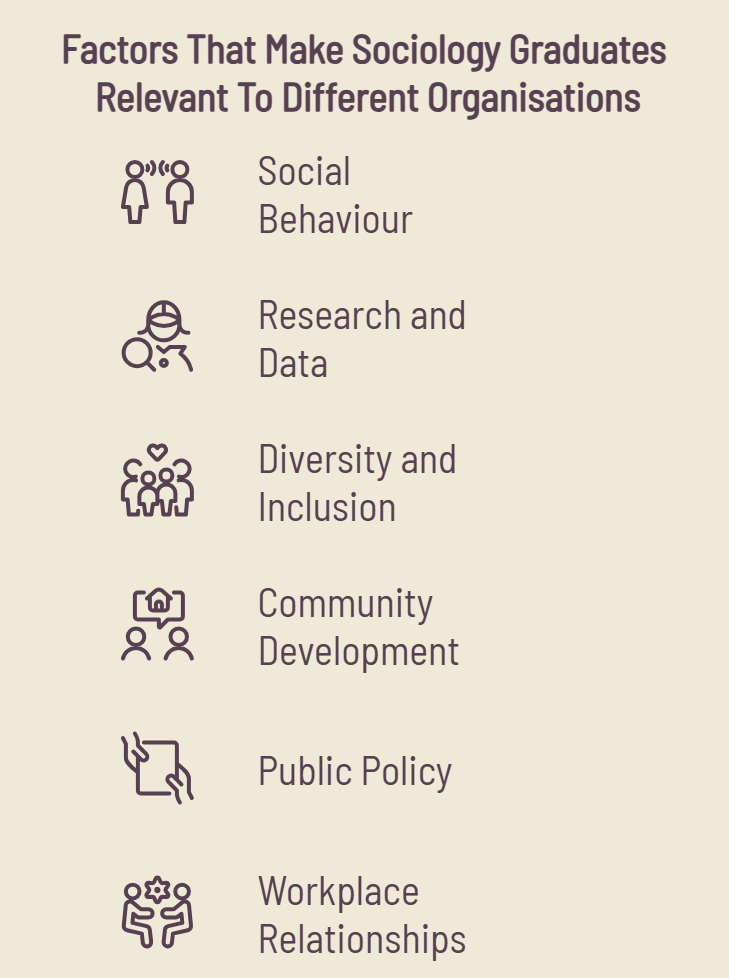
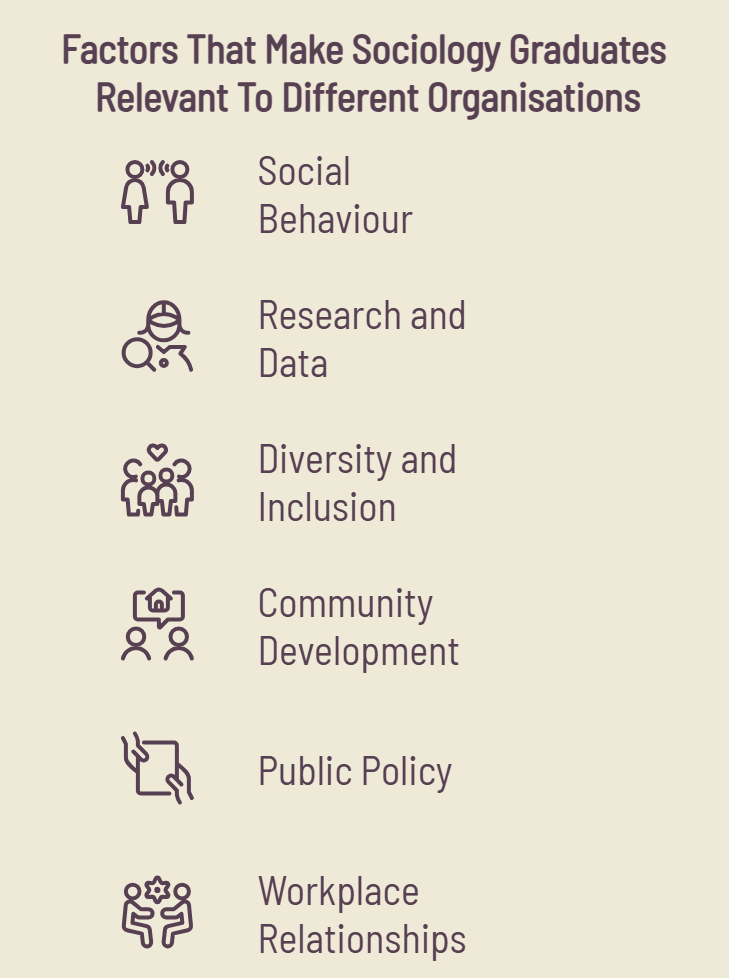
Understanding Social Behaviour: Organisations need to understand how people interact, make decisions and respond to changes in their surroundings.
Research and Data Interpretation: Research-based decision-making requires professionals who can collect information, study social patterns and interpret findings.
Growing Focus on Diversity and Inclusion: Companies and institutions are paying attention to workplace diversity, gender equality and inclusive practices.
Community Development Requirements: NGOs, government bodies and CSR departments need professionals who can understand community needs and support development programs.
Public Policy and Social Welfare: Social research helps institutions understand issues related to education, healthcare, employment and inequality.
Changing Workplace Relationships: Corporate organisations benefit from professionals who understand employee behaviour, group dynamics and organisational culture.
However, having an MA in Sociology does not automatically qualify someone for every position. Employers also consider practical experience, technical skills, additional qualifications and the specific responsibilities of the role.
Prepare for Diverse Career Opportunities with an Online MA in SociologyWondering which industries hire Online MA in Sociology graduates? Andhra University's Online MA in Sociology helps students develop an understanding of social structures, human behaviour and research methods that can support career opportunities across different sectors. Why consider Andhra University's Online MA in Sociology? Build a strong foundation in sociological concepts and theories. Develop an understanding of social issues, communities and institutions. Study research methods and social analysis. Explore subjects such as Indian Society, Gender Studies and Rural and Urban Sociology. Learn through a flexible online format with live sessions and LMS access.
Explore the Online MA in Sociology from Andhra University Online to learn more about the program, curriculum and admission requirements. |
What Job Roles Can You Explore After an Online MA in Sociology?
An Online MA in Sociology offers different career opportunities for research, teaching, community development, government, and corporations, among others, depending on your strengths and interests.
The following table compares some common industries hiring online MA in Sociology graduates, along with relevant job roles and average salary.
Industry | Job Roles | Average Annual Salary |
Education | Academic Research Assistant, Education Coordinator | INR 3.7 LPA |
Research | Social Researcher, Research Associate | INR 5 LPA |
NGOs and Non-profits | Program Officer, Field Researcher | INR 2.9 LPA |
Government | Policy Research Assistant, Social Welfare Officer | INR 4.5 LPA |
Corporate HR | HR Executive, Employee Engagement Executive | INR 3.8 LPA |
Social Development and CSR | CSR Executive, Development Coordinator | INR 5 LPA |
Source: AmbitionBox and Glassdoor
Different organizations have different roles and qualifications. For instance, the job of a researcher will demand proficiency in statistical packages while that of an NGO may prioritize fieldwork.
It is also worth checking the specific educational and professional requirements before applying for specialised positions.
For more information on career prospects, salary expectations and placement opportunities, read our guide to placement after an Online MA in Sociology.
What Skills Do Employers Look for in MA Sociology Graduates?
A postgraduate degree offers knowledge in the concerned area, but employers are equally interested in evaluating how well the candidate applies his/her knowledge in professional situations. Research, communication, and problem-solving skills are especially important for a career in Sociology.
Here are some skills worth developing during and after your MA:
Research methodology: Ability to formulate research questions, carry out interviews and surveys and gather reliable information.
Data analysis: Understanding of both quantitative and qualitative data analysis. Knowledge of Excel and SPSS will come in handy.
Communication skills: Training in presentation of research results, report writing and interaction with various audiences.
Critical thinking: Ability to analyze social problems from different angles rather than making assumptions.
Community interaction: Ability to interact with communities, visit them and understand their needs.
Report writing: Ability to structure the information and present the research results in a coherent way.
Project management: Ability to organize time and project processes and monitor its progress.
How can you prepare for these roles?
Along with developing these skills, consider taking a few practical steps:
Apply for internships with NGOs, research organisations or social development institutions.
Participate in research projects and try to present your findings through reports or academic papers.
Volunteer for community programs to gain experience in fieldwork.
Learn relevant tools such as Excel, SPSS and basic data visualisation software.
Consider additional qualifications in social work, public health, human resource management or development studies, depending on your preferred career path.
These experiences can help you demonstrate your understanding of Sociology beyond your academic qualifications.
Why Choose Andhra University for an Online MA in Sociology?
Andhra University Online offers the Online MA in Sociology which includes social structures, sociological theories, and research methodologies. The flexibility of online learning in this program enables the graduates to undertake post-graduation along with other academic/professional engagements.
Some of its key features include:
UGC Entitled Program: The Online MA in Sociology is listed as a UGC-entitled program, making program recognition an important consideration for prospective students.
NAAC A++ Accreditation: Andhra University holds an A++ grade from NAAC, reflecting its institutional accreditation status.
Flexible Learning: Students can access learning resources and recorded lectures through the university's Learning Management System (LMS).
Live Interactive Sessions: Learners can participate in live sessions and interact with faculty members and fellow students.
Research-Oriented Curriculum: The program covers subjects such as Research Methodology, Classical Sociological Theories, Indian Society, Social Structure and Change, and Rural and Urban Sociology.
Broad Understanding of Social Issues: Topics such as gender studies, society and education, ecology and environment help students examine different aspects of social life.
The program builds a foundation for careers in research, education and social development. Internships, practical experience and additional qualifications can further support career growth.
For learners balancing their studies with professional commitments, choosing the right course format is equally important. Read our guide on the best Online MA in Sociology for working professionals to understand what to consider when selecting a program.
Conclusion
An MA in Sociology can lead to varied career paths, but the right opportunity depends on your interests, skills and experience. As you plan your next step, focus on gaining practical exposure and choosing roles that align with your long-term goals.
Explore Andhra University's Online MA in Sociology to continue your academic journey and build your understanding of society and social issues.